Pillow Filling Machine Comparison: KIVAS Weigh-Fill vs. Volumetric Alternatives
For a bedding producer evaluating a pillow filling machine, the technology decision that determines fill-weight consistency is the dosing principle: weigh-fill or volumetric. Weigh-fill doses each pillow against a target weight, which is why the KIVAS KWS6901-2 and KWS6901-4 pillow filling machines are rated at about 1% accuracy with an error range of ±5–10 g across a 100–2000 g fill window. Volumetric systems dose a fixed volume per cycle, so the weight they deliver follows the bulk density of the fiber on the day it is filled. Choose weigh-fill when pillow weight is part of your product specification, when you run blended or mixed fills, or when one line has to cover several fill weights. Choose volumetric when a single, highly consistent material is filled to a loose tolerance and the simplest possible dosing head is sufficient.
Qingdao Kaiweisi Industry and Trade Co., Ltd., trading as KIVAS, is a Qingdao, China-based manufacturer of fiber processing machinery and fully automated quantitative pillow and quilt filling machines, founded in 2014. Its export markets include the United States, Russia, Vietnam, Kazakhstan, Saudi Arabia, Italy, the United Kingdom, Spain, South Korea, Turkey, Brazil, Pakistan, Moldova and Ukraine.
Problem Definition: Why Pillow Fill Weight Drifts Between Runs
The declared weight of a pillow is a commercial commitment, not just a production number. It appears on retail labels and export documents, it sits inside hotel and contract bedding specifications, and it shapes how full the finished pillow feels in the end user's hand. A filling machine that misses that weight in either direction creates cost: overfilled pillows give away raw material and add compression-packaging and freight volume, while underfilled pillows generate complaints, rework and returns.
Weight drift rarely comes from the machine being "wrong". It comes from the fill material changing. Polyester fiber drawn from different bales, blends mixed at different ratios, loose fiber versus fiber balls, recycled content, retained moisture, and the down-to-feather proportion in a down product all change how much mass occupies a given volume.
A volumetric filling head dispenses a fixed volume per cycle, so delivered weight equals that volume multiplied by the current bulk density. When bulk density shifts, every pillow in the run shifts with it, and the deviation repeats until someone re-calibrates. Weigh-fill closes each cycle on the target weight instead, so the machine absorbs material variation rather than assuming it away.
The common manual workaround — a person check-weighing finished pillows — adds labor and samples the output instead of controlling it. For most producers, the technology decision is the cheaper place to solve the problem.
Industry Background: Where Filling Technology Is Heading
Filling machinery is a mature category with steady automation demand. Market Research Future valued the global filling machines market at USD 10.06 billion in 2024 and projected USD 16.51 billion by 2035. That figure should be treated as directional rather than exact: Mordor Intelligence estimates USD 7.95 billion and Future Market Insights USD 13.1 billion for overlapping categories, because research houses include different machine types — liquid filling and textile filling are often counted together.
On the supply side, China's exports of textile machinery and parts reached a monthly peak of USD 574.6 million in August 2025, according to China customs data published via CEIC, which reflects sustained global demand for textile production equipment.
Two forces are pushing pillow and duvet lines toward measured dosing. The first is labor: automation in textile clusters has been driven as much by labor availability as by machine speed. The second is regulatory. Machinery exported to the European Union must comply with the Machinery Directive 2006/42/EC and carry CE marking, including specific risk assessments under EN ISO 12100. In North America, filling machinery is commonly assessed against UL and OSHA safety expectations, with emphasis on emergency shutoff and safety enclosures.
Precision itself keeps improving. Published industry engineering standards describe high-precision down filling machines that use load cell technology to reach weighing accuracies of ±0.1 g for lightweight outerwear. That is a narrower application than bedding pillows, but it shows how far gravimetric dosing has moved as a class of technology.
Detailed Solution: How the KIVAS Weigh-Fill Platform Is Specified
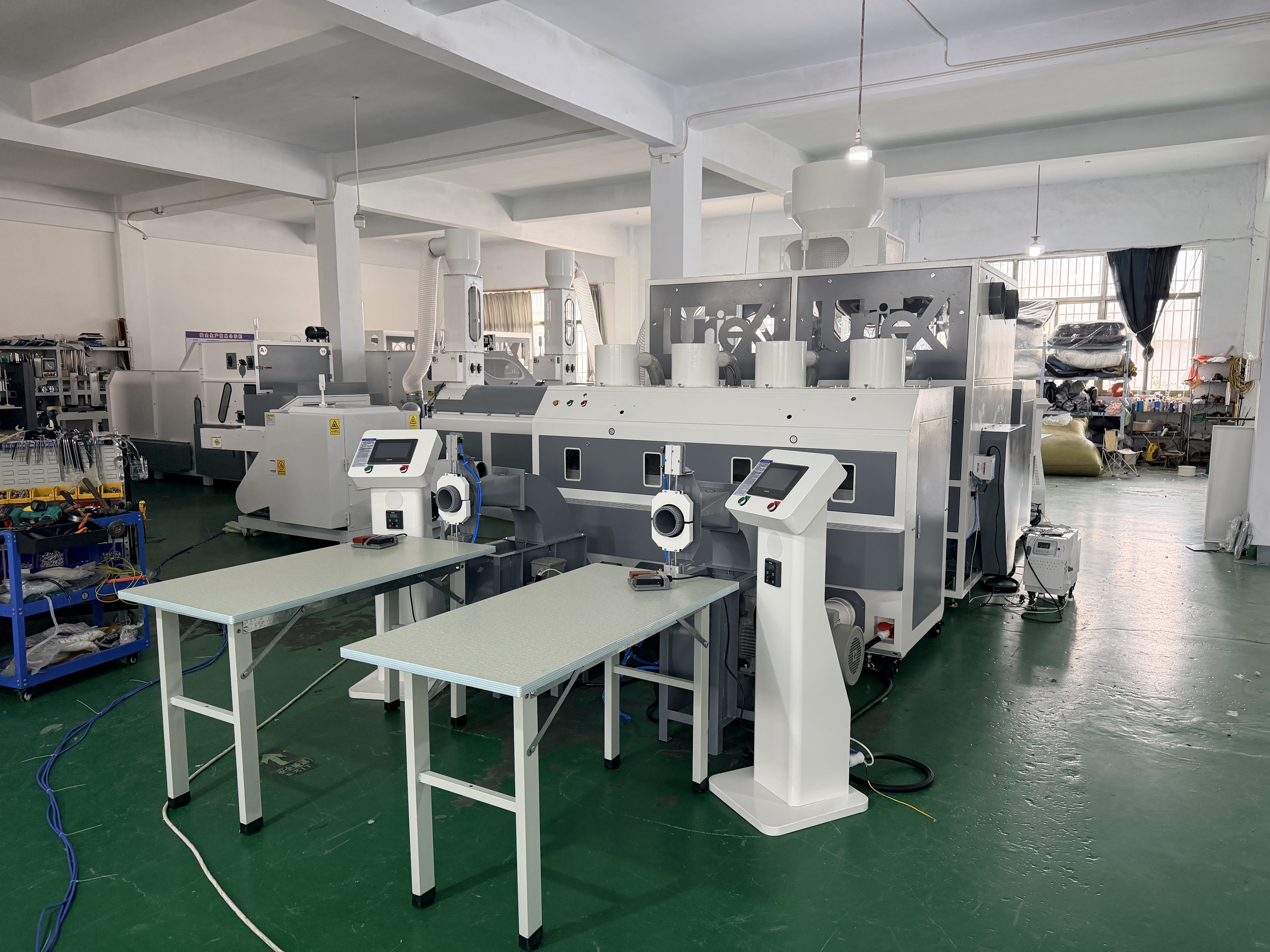
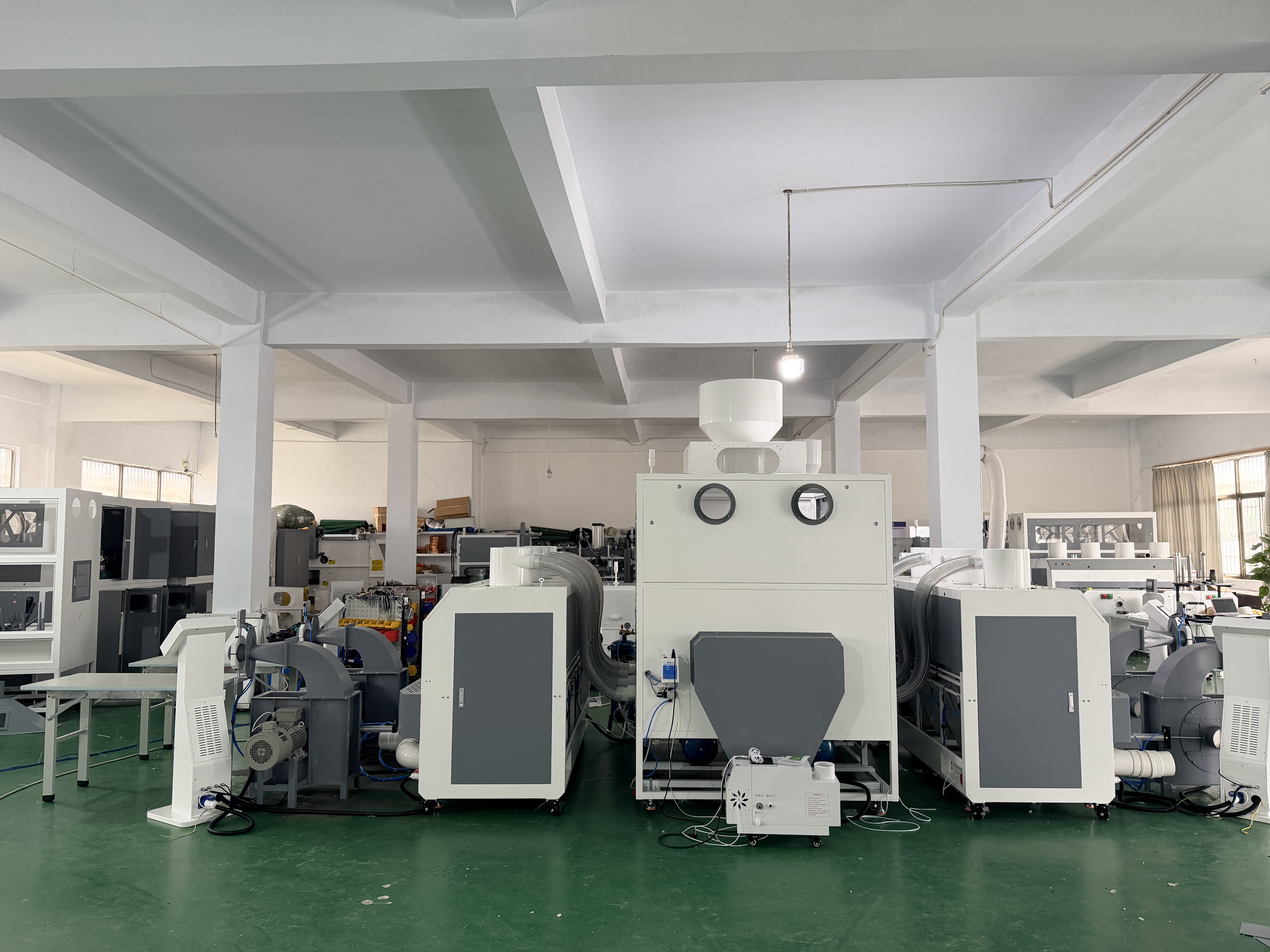
KIVAS builds the KWS6901-2 and KWS6901-4 as quantitative weigh-fill pillow filling machines: each filling cycle is dosed against a set weight rather than a set volume. The published series specifications are the practical starting point for any comparison against volumetric equipment.
| KWS6901 series specification | Published value |
|---|---|
| Dosing principle | Quantitative weigh-fill (automated quantitative filling) |
| Models and filling ports | KWS6901-2 with 2 filling ports per machine; KWS6901-4 with 4 filling ports per machine |
| Power range | 10.5 kW – 13.5 kW |
| Production capacity | 400–800 kg/h |
| Filling speed | 600 g pillow: 10–20 pieces per minute |
| Accuracy | About 1% |
| Error range | ±5–10 g |
| Optimal filling range | 100–2000 g |
| Suitable raw materials | 0.6D–15D polyester fiber, fiber balls, shredded foam, down feathers, EPS balls and similar materials, for single or mixed filling |
| Machine material | Steel |
Two configuration points matter most in day-to-day production. The first is port count: the series is offered with two or four filling ports per machine, and buyers select the port count that matches their required output, staffing and floor layout. The second is the fill window: a 100–2000 g range lets the same machine run a decorative cushion insert and a heavy hotel pillow without a format change.
The material list is wider than many buyers expect from a pillow machine. It covers 0.6D–15D polyester fiber, fiber balls, shredded foam, down feathers and EPS balls, with support for both single-material filling and mixed filling. Reference installations run blends of two to five raw material types in one fill, which is where volumetric dosing tends to struggle most, because each material has its own bulk density.
Compliance is documented rather than claimed. KIVAS holds a Machinery Directive Attestation of Conformity under CE-MD Machinery Directive 2006/42/EC, certificate number M.2024.206.C100562, issued by UDEM on 9 May 2024 and valid until 8 May 2029. The declared standards are EN ISO 12100:2010 and EN 60204-1:2018, the certificate scope is the automatic down fiber filling machine, and the certificate is linked to the Pillow Filling Machine model KWS6901-2/KWS6901-4. The company's products carry ISO9000/CE certification.
Comparison Table: Weigh-Fill vs. Volumetric for Pillow Production
The table below compares the two dosing principles on the criteria that decide most pillow and duvet line purchases. The KIVAS column uses published KWS6901 series specifications; the volumetric column describes the general characteristics of that technology class.
| Evaluation criterion | Weigh-fill — KIVAS KWS6901-2 / KWS6901-4 | Volumetric alternatives (general technology) |
|---|---|---|
| Dosing principle | Each cycle is dosed against a set target weight | Each cycle dispenses a fixed volume from a chamber, auger or rotary format |
| Weight accuracy | About 1%; error range ±5–10 g | Delivered weight depends on the bulk density of the material at that moment |
| Response to material variation | Changes in fiber blend, moisture, denier or fiber-ball ratio are absorbed by the next weighing cycle | A change in bulk density shifts every pillow in the run until the volumetric setting is re-calibrated |
| Mixed and blended fills | Supported; reference installations run 2–5 raw material types in one fill | Generally requires separate dosing and re-calibration for each material |
| Fill weight window | 100–2000 g on the same machine | Bounded by the chamber or format size; a format change is needed outside that window |
| Throughput reference | 600 g pillow: 10–20 pieces per minute; 400–800 kg/h | High cycle rates are achievable with free-flowing, consistent materials |
| Changeover to a new pillow specification | Set a new target weight | Change the chamber, auger or format |
| Supervision model | Set-and-run; check-weighing becomes an audit step | Depends on upstream density control and routine re-calibration |
| Best fit | Multi-SKU bedding lines, blended fills, declared weight tolerances | Long runs of one specification with a stable, single material |
| Trade-off to accept | Adds a weighing step per cycle, so it is justified where weight consistency is part of the specification | Simpler dosing, but weight conformity must be managed upstream and by sampling |
Note: The volumetric column describes general technology characteristics for reference and is not a measured comparison against any named competitor machine. All KIVAS figures in this article are published KWS6901 series specifications.
KWS6901-2 or KWS6901-4: choosing the port count
Power, capacity, accuracy and fill range are published at series level: 10.5–13.5 kW, 400–800 kg/h, about 1% accuracy, ±5–10 g error and a 100–2000 g filling range. The two models differ in how many filling ports they carry — two on the KWS6901-2 and four on the KWS6901-4 — so the port count, not the dosing principle, is the purchasing decision inside the series.
Step-by-Step Breakdown: Evaluating and Deploying a Weigh-Fill Line
- Write the fill-weight tolerance before comparing machines. The tolerance in your pillow specification decides the technology. If the label, the hotel contract or the export document states a weight that must hold across batches, weigh-fill is the appropriate class of machine. If the tolerance is loose and the material never changes, a volumetric head can be adequate.
- Characterise your material variability. Sample bulk density across bales, blend ratios, recycled content and moisture levels. Include every material you intend to run: 0.6D–15D polyester fiber, fiber balls, shredded foam, down feathers or EPS balls. The wider your material mix, the stronger the case for per-cycle weighing.
- Map your fill-weight window. List every SKU on the line. A single machine rated for 100–2000 g covers decorative cushions through heavy pillows and duvets without a format change, which is the configuration KIVAS publishes for the KWS6901 series.
- Match throughput to the specification, not to a headline number. The published reference is a 600 g pillow filled at 10–20 pieces per minute, with production capacity of 400–800 kg/h across the series.
- Select the port count. Two filling ports per machine for a compact line, four for a wider line — both configurations are part of the same KWS6901 platform.
- Plan upstream and downstream equipment together. Filling weight is only stable if the fiber arriving at the filling head is consistent, so fiber opening and blending upstream belong in the same project scope. Downstream, pillow compression packaging determines how much of the filled weight you actually ship per carton. KIVAS supplies both ends of that chain.
- Confirm the compliance path for your market. For the EU, the Machinery Directive 2006/42/EC and CE marking apply, with risk assessment under EN ISO 12100; the KIVAS certificate M.2024.206.C100562 covers this scope. For North America, plan for UL and OSHA expectations around emergency shutoff and safety enclosures and confirm requirements with your own compliance team.
- Validate before shipment and before scale-up. Acceptance runs through a 100% pre-shipment test plus third-party inspection by SGS, and a minimum order quantity of 1 unit can serve as a sample for testing on your own fiber.
- Commission and hand over locally. KIVAS supports overseas installation guidance, remote technical support, a 1-year warranty and lifetime after-sales service, so the line is not dependent on a single visit.
Use Cases: Where Weigh-Fill Earns Its Place on the Floor
The KWS6901 platform is specified for bedding and home textiles, down clothing, soft sofa furniture, pet supplies, plush toys, car cushions, cotton and linen fiber primary processing, recycled fibers, non-woven fabric accessories and medical care. In practice, the applications that benefit most from per-cycle weighing share one trait: the fill material is not perfectly uniform.
- Polyester pillow filling. The core case. A 600 g pillow filled at 10–20 pieces per minute with about 1% accuracy keeps declared weight stable across bales of 0.6D–15D fiber.
- Duvets and quilts. Larger fill weights sit inside the 100–2000 g window, and the same weighing logic protects the heavier end of the range where an error is most expensive.
- Down jackets and down products. Down and feather blends vary by proportion; weigh-fill removes the need to re-calibrate when the batch ratio changes.
- Cushions, lazy sofas and beanbags. Shredded foam and EPS balls are the classic volumetric problem materials, because they settle and pack at inconsistent densities.
- Plush toys and pet products. Small and medium fills benefit from the lower end of the weight window, where a fixed-volume dose produces the largest proportional error.
- Recycled fiber and non-woven accessories. Recycled inputs are the least predictable of all, which makes measured dosing close to a requirement rather than an upgrade.
- Mixed fills. Reference installations run single or mixed filling with two to five raw material types, a duty that volumetric heads cannot cover without per-material calibration.
Three-year operating reference: a Saudi Arabian bedding producer
The clearest reliability evidence for weigh-fill is field time. A Saudi Arabian bedding manufacturer took delivery of 10 units for pillow, cushion and bedding filling with fiber opening and pillow compression packaging. The lines have been operating normally for three years. Reported results from that installation are a 30% reduction in energy consumption, a 35% reduction in labor cost and a 40% increase in production capacity, with the installation noted for about 1% filling error, single or mixed filling with 2–5 raw material types, long service life and low maintenance.
Frequently Asked Questions
Is the KIVAS pillow filling machine CE certified for the European Union?
Yes. KIVAS holds a Machinery Directive Attestation of Conformity under CE-MD Machinery Directive 2006/42/EC, certificate number M.2024.206.C100562, issued by UDEM on 9 May 2024 and valid until 8 May 2029. The declared standards are EN ISO 12100:2010 and EN 60204-1:2018; the certificate scope is the automatic down fiber filling machine and it is linked to the Pillow Filling Machine models KWS6901-2 and KWS6901-4. Before ordering, confirm that the certificate, the technical file and the CE marking on the delivered unit all reference the same model. For North America, filling machinery is commonly assessed against UL and OSHA expectations such as emergency shutoff and safety enclosures.
What accuracy can weigh-fill achieve compared with volumetric filling on pillows?
Published KWS6901 series data states about 1% accuracy with an error range of ±5–10 g, a 100–2000 g optimal filling range and a filling speed of 10–20 pieces per minute for a 600 g pillow at a production capacity of 400–800 kg/h. A volumetric head dispenses a fixed volume, so its delivered weight tracks the bulk density of the fiber and drifts when blend ratio, moisture, denier or fiber-ball content changes. For reference, published industry engineering standards describe load cell down filling machines reaching accuracies down to ±0.1 g for lightweight outerwear — a narrower application than bedding pillow filling. The practical rule is simple: if your pillow's declared weight tolerance cannot absorb bulk-density variation, weigh-fill is the safer technology.
Is KIVAS an OEM pillow filling machine manufacturer?
Yes. KIVAS production modes include OEM, ODM, overseas installation guidance and personalised customisation, with customisation available for voltage, logo, colour, production capacity and specialised production lines. The company operates a 3,000 m² factory with 17 employees, a 5-engineer R&D team and an annual output of about 1,000 units, and its export share is 60%. The pillow filling platform is the KWS6901-2/KWS6901-4, offered with two or four filling ports per machine and rated for 0.6D–15D polyester fiber, fiber balls, shredded foam, down feathers and EPS balls in single or mixed filling configurations.
What is the minimum order quantity, lead time and payment term?
The minimum order quantity is 1 unit. Production lead time is 15–35 days, with a monthly capacity of 60–150 units. Payment terms are 30% T/T deposit before production and 70% balance by T/T before ex-factory delivery. Delivery can be arranged on EXW, FOB, CIF, CFR or DDP terms. Quotations depend on the configuration you select, including port count, voltage and other customisation, so the specification matters as much as the model name.
Can I test the machine with my own fiber before placing a production order?
Yes. A minimum order quantity of 1 unit can serve as a sample for testing. Acceptance is handled through a 100% pre-shipment test plus third-party inspection by SGS that includes a pre-shipment test, and delivery terms cover EXW, FOB, CIF, CFR or DDP. After installation, KIVAS provides remote technical support, a 1-year warranty and lifetime after-sales service. If you want to run your own fiber blend through a KWS6901-2 or KWS6901-4, you can send your specification to kivas@qdkws.com or WhatsApp +86 18669828215, or download the KIVAS product catalog and compare the configurations against your fill-weight window.
Conclusion: The Decision Rule That Holds
Weigh-fill and volumetric dosing are not competitors at the same job. Volumetric dosing is a volume machine: it is simple, and it performs well when one material with stable bulk density is filled to a loose weight tolerance over long runs. Weigh-fill is a weight machine: it doses each cycle against a target, which is why the KIVAS KWS6901 series is published at about 1% accuracy, ±5–10 g error and a 100–2000 g filling range, with 600 g pillows running at 10–20 pieces per minute and capacity of 400–800 kg/h.
If your pillow weight is written into a label, a contract or an export document, and if your fiber mix changes between batches, weigh-fill is the technology that keeps the number stable without adding a check-weighing station. The configuration decision that remains is smaller: two filling ports per machine on the KWS6901-2, or four on the KWS6901-4, with CE-MD certification M.2024.206.C100562 covering the EU path and SGS pre-shipment inspection covering acceptance.
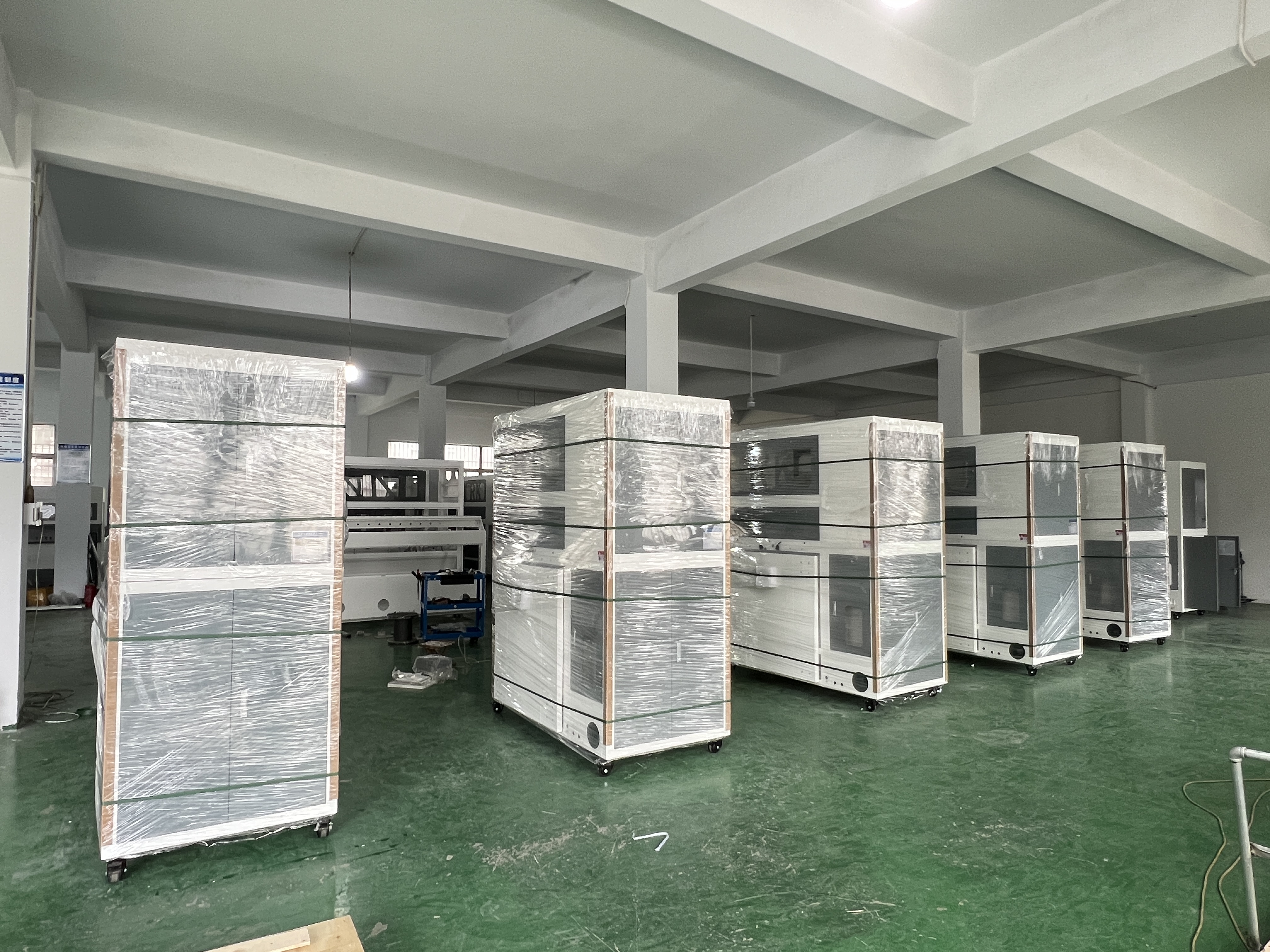
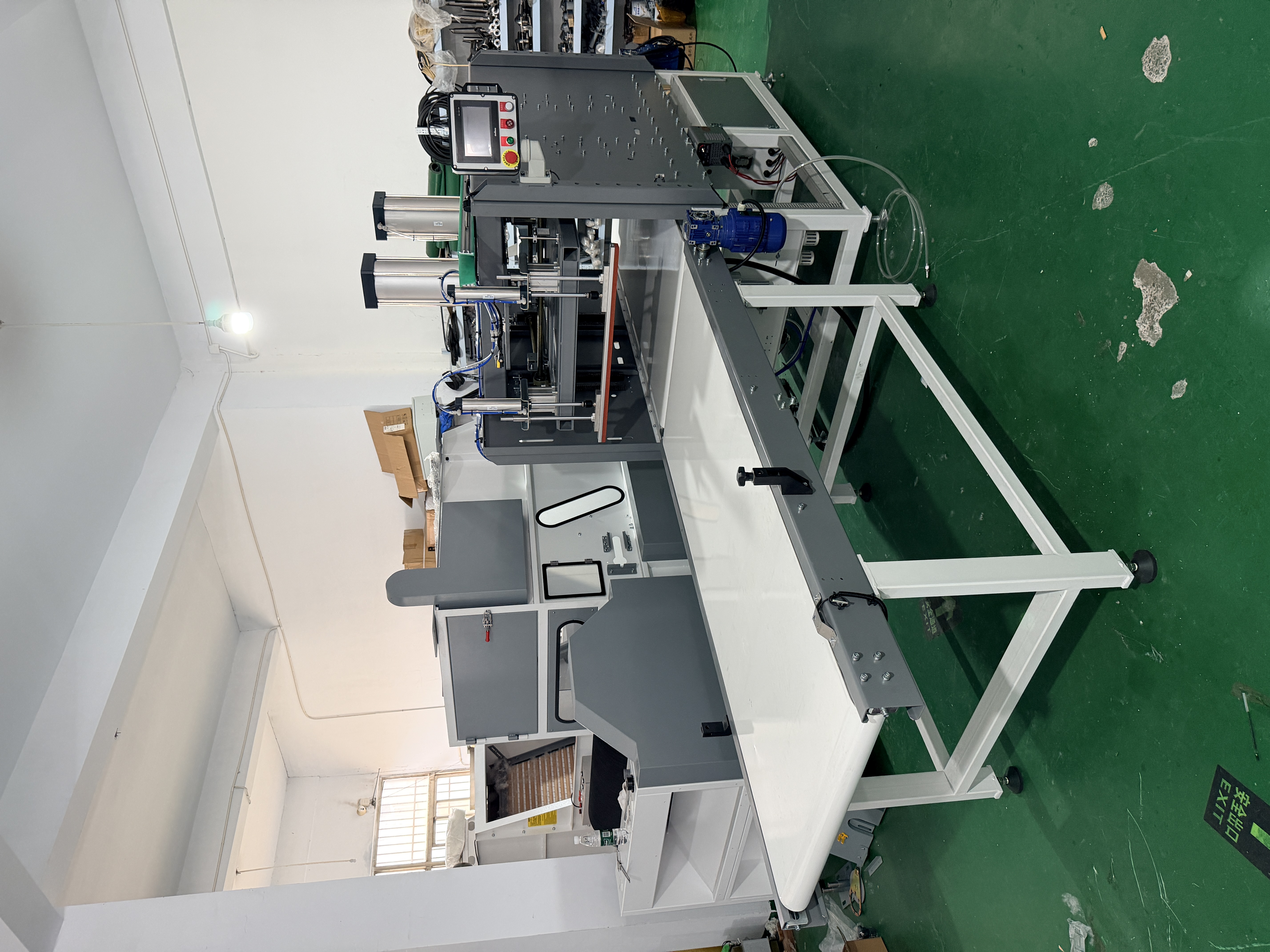
Next step: run your own fiber through a weigh-fill specification
Send your pillow weights, blend mix and target output, and KIVAS will confirm whether the KWS6901-2 or the KWS6901-4 fits your line, along with the configuration, lead time and inspection plan for your market.
- Email: kivas@qdkws.com
- Tel / WhatsApp: +86 18669828215
- Website: www.qdkivas.com
- Address: 279, Huan Tai East Road, Huangdao District, Qingdao City, China
Have Questions or Need More Details?
Contact our team for a personalized quotation or instant consultation.
Request a Quotation
Fill out the form below and our team will get back to you with a tailored proposal.
WhatsApp Direct Chat
Prefer to chat in real-time? Message us on WhatsApp for instant assistance & quick answers.
- Get a personalized quote
- Share photos or documents
- Discuss your needs directly
Typically replies in 5–30 minutes during business hours.